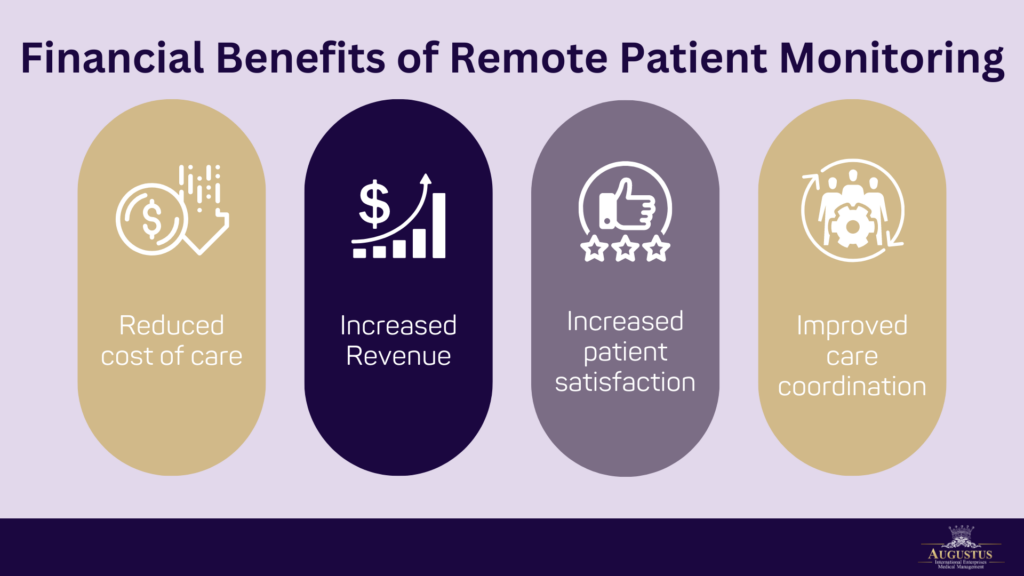
We’ve heard a lot about RPM and the ability to gain significant revenue just by implementing the program in your healthcare organization. In this two-part series we’ll talk about the financial benefits, as well as things to keep in mind in order to effectively implement an RPM program. The financial benefits of implementing remote patient monitoring (RPM) in a medical practice can vary depending on a number of factors, such as the size of the practice, the patient population, and the type of monitoring provided. However, there are several potential cost savings and revenue opportunities associated with RPM:
- Reduced costs of care: RPM can help to reduce the cost of care by reducing the need for in-person visits, hospitalizations and readmissions, and emergency department visits. This can result in significant cost savings for the practice.
- Increased revenue: RPM can provide an opportunity to bill for additional services, such as remote consultation or monitoring. This can result in increased revenue for the practice.
- Increased patient satisfaction: RPM can help to improve patient outcomes and satisfaction, which can lead to increased patient retention and the potential for new patient referrals.
- Improved care coordination: RPM can help to improve care coordination between providers and across care settings, which can lead to better care coordination and improved patient outcomes.
It’s important to note that the financial benefits of RPM can vary depending on the specifics of your practice such as patient population, the type of RPM you choose to implement, and the reimbursement policy of your payers. It’s important to conduct a financial analysis of the costs and potential benefits of implementing RPM in your practice, which can give you a clearer picture of the potential financial returns of implementing this type of service.
Additionally, keep in mind that the financial benefits of RPM may take time to materialize and may depend on how well the program is implemented and adopted by patients and staff. It’s important to track and evaluate the program over time to ensure that it is meeting its goals and delivering the expected financial benefits.
AIE Medical Management can assist you in determining if implementing an RPM program makes sense for your healthcare organization. Contact us to learn more.
Author
-
Healthcare executive and physician-trained operator focused on building organizations that support physicians — not just service them.
I founded AIE Medical Management to reduce administrative burden and serve as a strategic partner to providers navigating operational complexity, revenue pressure, and technology overload. My approach is simple: align clinical integrity with operational discipline.
Over the past 15+ years, I’ve led and advised healthcare and healthtech organizations across startup and enterprise environments — from growth-stage companies building infrastructure to established, revenue-producing organizations seeking scale and stability.
My work spans medical management, revenue cycle optimization, healthtech enablement, hybrid care models, and executive-level operational leadership.
I operate across C-suite, President, and senior leadership roles, including interim and fractional engagements, partnering with founders, boards, and investors to strengthen operations and advance mission-driven healthcare.
Open to conversations with healthcare and healthtech organizations focused on sustainable growth and real impact.